Shoppers have never known more about what they want than they do today. Early in my career I remember writing decision trees for the grocers, today decision trees have evolved into complex webs for an ever more segmented shopper base.
Personal needs, crowded shelves
Health is a prime example. A decade ago, "healthy" was a broad idea: less fat, less sugar, get your 5 a day. Today it is deeply personal. People shape their choices around their life stage, working patterns, training goals and, increasingly, their medication. Social feeds, wearable tech and AI LLMs feed us advice tailored to our own body and lifestyle.
Picture two shoppers reaching for the same kefir in the chiller. One is in her late twenties and wants to feel better now; less bloating, clearer skin and a steadier mood. The other is in his sixties and is thinking long term; immunity, digestive resilience and staying well as he ages. Gut health is a top health priority for both men and women, so the brand wants both of them. But one pack has a few square centimeters to speak to both, and the cue that reassures one may mean nothing to the other. This is a relatively simple case study.
This is the paradox brands and retailers now face. Needs are fragmenting into ever finer, more personal goals that appear functional on the surface but are deeply personal to each individual. However, shoppers don't have any more time than they had a decade ago when I was writing those decision trees. They still have just a few seconds at fixture. But more complexity in terms of needs can lead to uncontrolled product innovation, ultra tailored messaging and a category that no longer fits in an aisle or doesn't have a natural home in store.
Below, we look at how this plays out in three categories, and what it means for the way products are developed, packaged and merchandised.
Laundry: A category that only becomes more complex
Laundry used to be one of the simplest weekly routines in the home. Our own research shows it is becoming one of the most personalised. Swift's own laundry purchase tracker shows how, over a relatively short period, the huge increase in usage of scent boosters. It shows that even the most popular brands and variants are only bought by a small % most often.
A single household now homes multiple laundry jobs to be done. One family member has sensitive skin, another prefers a fresher, more masculine scent, while someone else wants something softer and floral. Gym kit needs odour control, children's clothes need stain power, and delicates need care. Many households are also choosing shorter, cooler cycles to save energy and money, and using scent boosters to make fragrance last longer.
The category has responded with choice. Liquids, capsules, powders and sheets sit alongside softeners, boosters, stain removers and sanitisers. Each comes in a growing range of scent variants and pack sizes. For the shopper, that range is valuable at home but confusing at the fixture.
That is why clarity matters more than ever. Two things make the biggest difference:
- Mission-led merchandising. Shoppers navigate by cues they already know, such as colour blocking for whites, colours, sensitive and fragrance-led products. Fixtures that follow the shopper's mission are quicker to shop than ones organised purely by brand or format.
- On-pack messaging that answers "why this, and who for?" A clear reason to buy, such as "for sensitive skin", "for sportswear" or "effective at 20°C", helps the shopper match the product to the job in seconds.
Drinks on the go: on the go is no longer the mission
Picture the lunchtime meal deal chiller. The shopper has a few seconds, dozens of options, and a different need depending on the day.
On Monday it might be a morning kick-start. On Tuesday it is post-gym recovery, and on Wednesday it is beating the 3pm slump. Other days it is simple hydration at the desk, a midweek treat, or just "I'm bored of what I usually have". Each of these is a different job to be done, and each asks something different of the product. That might be protein, electrolytes, vitamins, caffeine, refreshment, indulgence or novelty.

At the same time, flavour innovation has exploded. New and unexpected flavours are one of the strongest ways to earn attention, especially for long-standing brands looking to grow. But here lies the tension. A novel flavour is perfect for the discovery or boredom-breaker job. Put that same flavour on a protein shake, though, and the shopper has to work out whether it is a treat or offers a functional benefit.
Meanwhile, some chillers are still organised by brand or format, such as cans, bottles and cartons, rather than by mission. The shopper is left to do the translation.
The brands that win will signal the job first and let flavour do the tempting second. That might mean grouping products by need, giving the functional benefit pride of place on pack ("20g protein", "electrolytes"), and choosing flavours that reinforce the job rather than distract from it.
Fragrance and personal care: scent for every moment
Fragrance has always been personal. What is changing is how many roles a single person now asks it to play.
Shoppers no longer pick one signature scent and stick with it. They layer body washes, lotions, mists and deodorants. They choose scents to match a mood, a moment or an outcome: energising in the morning, calming before bed, confident for a big meeting, fresh after the gym. Social content has fueled this, with endless "scent combos" and dupes encouraging experimentation.
The result is a fast-growing web of formats, fragrance families and functional claims. Body mists sit next to fine fragrance. Deodorants promise 72-hour protection alongside mood-lifting scents. Many products now claim both a sensory benefit and an emotional one.

For the shopper, the challenge is translating a feeling into a product. Most cannot smell everything on shelf, and many buy online without smelling at all. So the pack, the name and the fixture have to communicate what a scent will do for them, not just what it smells like.
This is where sensory understanding becomes a commercial advantage. Knowing which fragrance notes people associate with energy, calm, cleanliness or confidence lets brands build cues into colour, language and imagery. Done well, the shopper can find the right scent for the right moment without trial and error.
So what? Personal needs, simple shelves
Personalisation is not going away. If anything, it will accelerate. Shoppers are better informed, their social feeds are more tailored, and AI tools are starting to give them recommendations built around their own lifestyle. Each of these pushes needs to become more specific.
But the shopper's time at the shelf is not getting any longer. That leaves retailers and manufacturers with a clear responsibility; no matter how complex the needs become, buying should stay simple. That means merchandising that keeps pace with how people actually shop, and pack call-outs that lead with the ingredients or benefit that does the job, such as protein, electrolytes or "for sensitive skin".
How research can help
Traditional tools still have a role. TURF analysis, for example, is a good way to find the range of products or flavours that reaches the most people. But it tells you which items to stock, not why each one earns its place or what its pack needs to say.
At Swift, we start with the shopper's job to be done and build from there:
- Map the jobs. We identify the jobs shoppers hire the category to do, such as post-gym recovery, an afternoon pick-me-up or a gentle wash for sensitive skin.
- Size the jobs. We measure how many people have each job and how often it occurs, so effort goes where the value is.
- Define what each job needs from the category. We identify the functional benefits required to do each job well.
- Find the overlaps. Using correspondence analysis, we map jobs against benefits. This shows where jobs cluster, and which benefits work hard across several jobs at once.
- Connect function to feeling. Finally, we link those functional benefits to the emotional meaning shoppers attach to them.
That last step matters, but not in the way you might expect. The emotional meaning rarely needs to be spelled out on pack, because shoppers bring it themselves. "20g protein" can mean "look bigger" to one person and "stay strong while I lose weight" to another, and both walk away feeling more confident. The brand's job is to make the functional benefit unmistakable and leave room for that meaning, rather than narrowing it with a single emotional message that would exclude someone else. Understanding the meaning still matters: it tells you which benefit to lead with, and which images, words or tone might shut a shopper out.
Laundry manufacturers are struggling to understand how current missions overlap with these shorter colder, wash cycles. This can be answered by following the steps above. An illustrative example below shows how complexity can be reduced. Grouping jobs to be done by what matters most for that job can create a territory for innovation, help prioritize messaging on pack and support merchandise planning.
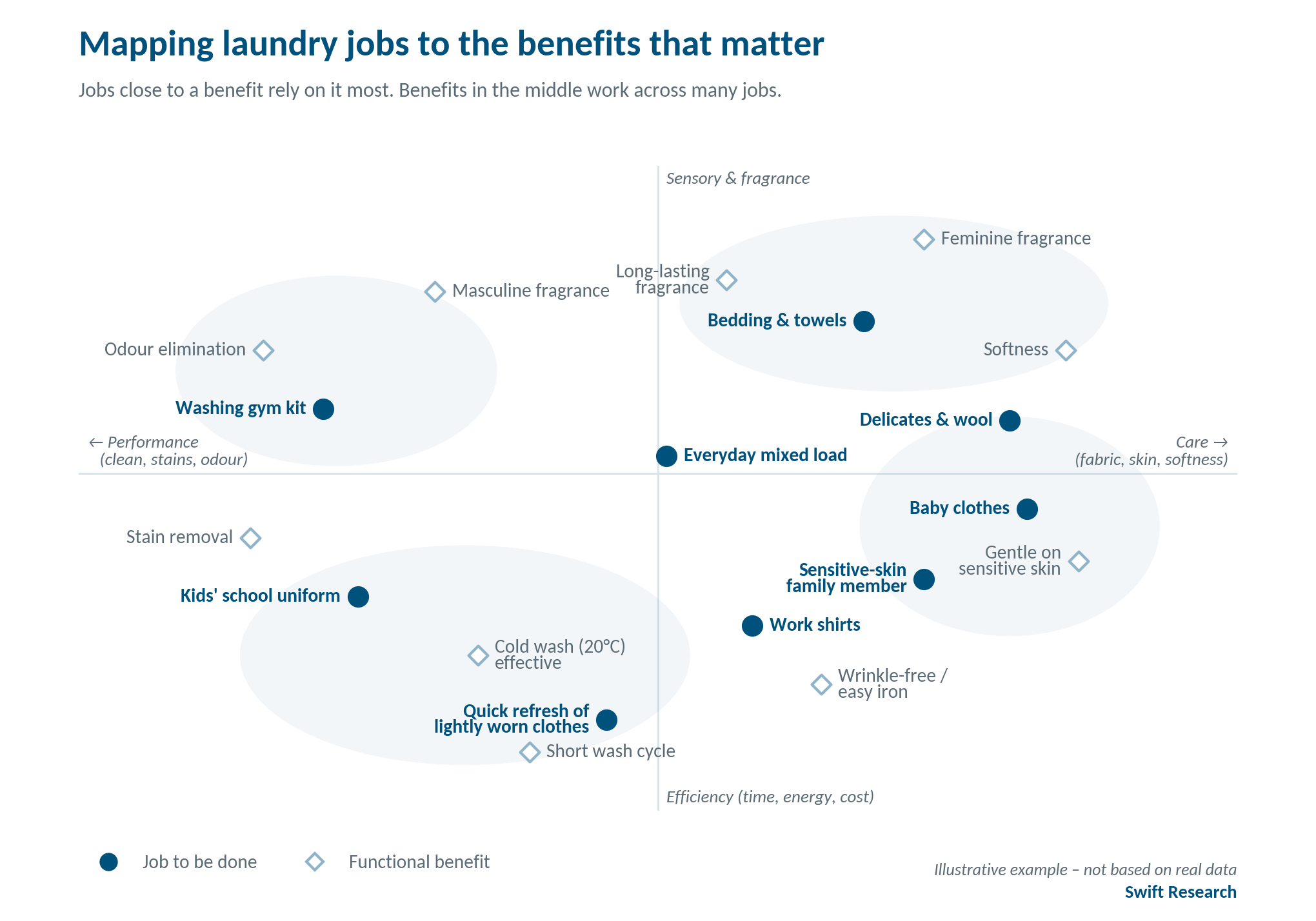
Example image generated with support of AI
The outcome is a clear view of which products to develop, how to group them on shelf, and what each pack must say to win the shopper in those crucial few seconds.
It is one of the ways we help clients research SMARTER. If personalisation is making your category harder to shop, we would love to talk.
Anthony Carter is our Head of Research, drop him a line today info@swift-research.co.uk.
